Thursday, October 28, 2010

Poster of the Week


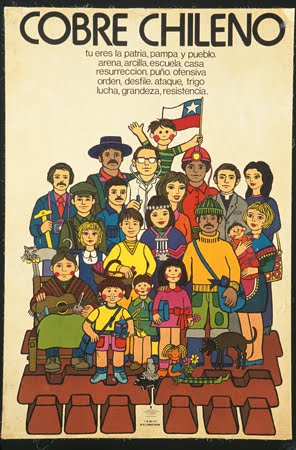
Cobre Chileno/Chilean Copper
Vicente and Antonio Larrea
Offset, 1972
Santiago, Chile
Translation:
You are the fatherland, the pampa (prairie) and people, sand, clay, school, house, resurrection, fist, offensive, order, parade, attack, wheat , struggle, grandeur, resistance.
On October 13, 2010, the world celebrated the incredible rescue of 33 Chilean miners trapped 2,000 feet underground for 69 days in a gold and copper mine near Copiapó a desert city in Northern Chile. For the first 17 days, no one knew if any had survived the mine’s collapse, and the miners were in complete isolation. As much of the world anxiously watched the miner’s harrowing ordeal, few were aware that the mine owners in their generosity did not pay the men's wages while they were trapped underground.*
The joy and relief over their rescue must also not prevent more critical views of the circumstances leading up to the collapse. The San José mine had a history of accidents: over a dozen lives have been lost there in recent years. It became so unsafe in 2007 it had to be closed – but not for long. On July 30, 2010, a Chilean labor department report warned again of “serious safety deficiencies”, but the minister took no action. Six days later, the men were entombed. We should not even be calling it an “accident” when it appears to be a crime caused by negligence and greed. **
As Chilean President Sebastian Piñera hugged each miner as they came out of the narrow escape shaft, it is important to remember how Chilean miners were murdered nearby under the Pinochet dictatorship just decades earlier.
In 1970, Salvador Allende was democratically elected President of Chile, despite active intervention by the United States to thwart his election. On September 11, 1973, Allende was overthrown by a C.I.A. instigated coup led by General Augusto Pinochet. Under Pinochet’s brutal dictatorship over 20,000 were killed or disappeared, and an estimated 1,000,000 were in exile following the coup.
On October 17, 1973, just a month after the coup and 37 years before the mine rescue— almost to the day — one of Pinochet’s death squads murdered 16 men in Copiapó, including some copper miners. This same death squad, which came to be called the Caravan of Death, killed more than 70 Chileans suspected of leftist activities that month alone.
CSPG’s Poster of the Week commemorates the period before Pinochet’s coup against Chilean democracy. The text was taken from a poem by Pablo Neruda. Its use on the poster celebrates President Salvador Allende’s nationalization of copper in 1971, Chile’s main export and a national symbol. The poster shows all classes of Chilean society united in the cause — including the soldier who, as representative of the Chilean armed forces, would (with U.S. help) oust Allende and overturn his socialist programs just one year later.
**Not unlike British Petroleum—BP—which has one of the worst safety records of any oil company operating in the U.S. With the April 20, 2010 explosion of the Deep Water Horizon in the Gulf of Mexico, BP is responsible for the worst oil spill in U.S. history. With a long history of negligence and safety violations, this too should be called a crime, not an accident.
Read More:

Friday, October 8, 2010

Posters of the Week

Modern Electric Chair
Juliano Ijichi Machado
Brazil

Requiem para los del 3 de mayo
Vladimir Sabillón
Honduras

JUSTICE/EDALAT
Aida Torkamani Asl
Iran

It must be stopped
Natalia Lazarashvili
Georgia

Death is Not Justice*

The Center for the Study of Political Graphics’ Posters-of-the-Week commemorates October 10, 2010, the 8th World Day Against the Death Penalty.

The death penalty is a violation of human rights, and more than two thirds of countries in the world have banned executions. 58 still persist in killing people in the name of “justice.” In 2009, countries with the highest number of executions were Iran (with at least 388 executions), Iraq (at least 120), Saudi Arabia (at least 69), and the United States (52). In China information regarding the death penalty remains a secret, but according to Amnesty International China executes more people than the rest of the world combined.

Recently retired Supreme Court Justice John Paul Stevens, 90, said that the lone vote he regrets in his nearly 35 years on the High Court is one that he cast to restore the death penalty in 1976. **

To educate and inspire people to work against the death penalty, we are featuring some amazing posters produced for Poster for Tomorrow, an independent, non-profit organization based in Paris and founded by Hervé Matine. Matine invited Carol Wells, CSPG’s founding director to be one of 100 online international curators to select the top 100 posters out of several thousand submissions. A live jury then picked the 10 winning posters which can be seen at http://www.posterfortomorrow.org/

The ten winning designs will become part of the permanent collection of nine internationally acclaimed design museums. The Center for the Study of Political Graphics will be the only U.S. institution to receive them. The other museums are:

- Dansk Plakatmuseum, Denmark
- Design Museum Gent, Belgium
- Graphic Design Museum, The Netherlands
- Lahti Poster Museum, Finland
- Les Arts Decoratifs, France
- Museum für Gestaltung, Switzerland
- Wilanow Poster Museum, Poland
- Victoria and Albert Museum, England

Most of the activities of Poster for Tomorrow promote active citizenship through the medium of design. They want to encourage people, both those in and outside the design community, to make posters to stimulate debate in the local and international communities on issues that affect us all.

* The title of the anti-death penalty design organized by Poster for Tomorrow .

**For more on Steven’s thoughts on the death penalty and the interview:

http://www.npr.org/templates/story/story.php?storyId=130198344


http://www.huffingtonpost.com/2010/10/04/john-paul-stevenss-one-re_n_749109.html

Thursday, September 30, 2010

Poster of the Week

Build A Wall Of Resistance
Fireworks Graphics
Silkscreen, circa 1980
San Francisco, California

CSPG’s Poster-of-the-Week has been reproduced a number of times over the past thirty years, always in response to FBI harassment of activists and Grand Jury subpoenas. It is currently being reissued after FBI SWAT teams broke down doors of anti-war leaders and activists in Minneapolis and Chicago on Friday, September 24, 2010. The activists were served with Federal Grand Jury subpoenas; personal papers, photographs, computers and cell phones were seized.

Friday’s raids came on the heels of a Justice Department probe that found the FBI improperly monitored activist groups and individuals from 2001 to 2006. Just two days earlier, the Boston Globe published an editorial about contemporary red-baiting, and how groups such as The Catholic Worker and The Thomas Merton Center—which had absolutely no connection with 9-11—were being investigated by the FBI. For more on the FBI’s ongoing post 9-11 war against dissent, targeting environmental, peace and social justice groups see: http://warisacrime.org/content/inspector-general-criticism-doesnt-faze-fbi-raids-midwestern-anti-war-activists.

Poster history—Build a Wall of Resistance: Don’t Talk to the FBI.

This poster, designed by Fireworks Graphics Collective in San Francisco in the late 1970s, was silk-screened on newsprint and posted on the street. Its purpose was, and is, to inform people that they do not have to talk to the FBI, and that refusing to talk to the FBI or testify to Grand Juries are ways of supporting the movement for social change. It was one in a series of posters supporting members of the Puerto Rican independence movement in Chicago, New York, and Puerto Rico, who were being harassed by the FBI and being subpoenaed to testify at Grand Juries. Several people went to jail for refusing to appear, but no one testified, and the Grand Jury was unable to break the solidarity of the movement.

It was reprinted several times in the 1980s, including in 1984 to support members of the John Brown Anti-Klan Committee in SF (JBAKC), who had been subpoenaed to a Grand Jury in Chicago under the ruse that a threatening letter had been sent with the JBAKC mailbox in San Francisco as the return address. After a few months of refusal to testify, the Federal Attorney dropped what was one of their more blatant fishing expeditions.

In 2005, three new San Francisco Grand Juries occasioned another reprinting of the Build a Wall poster.

Several environmental and animal rights activists were subpoenaed to a Grand Jury fishing expedition about small explosive devices that went off outside at Chiron corporation, an Emeryville (SF Bay Area) biotechnology firm, and Shaklee corporation in Pleasanton. The government was unable to find the suspect, so tried to get friends and animal rights activists to testify against him and the movement. It is believed that everyone resisted testifying, and the Grand Jury eventually died.

Also in 2005, Josh Wolfe, a San Francisco activist and videographer, was subpoenaed to a Federal GJ for video he took at a demonstration at which a policeman was injured. The San Francisco prosecutor refused to bring charges, so the police lied and said that the policeman’s car had been burned, and got a federal Grand Jury to subpoena Wolf based on the spurious “evidence” that since the Federal Government gave money to the SF police, the Feds had an interest in the car, and a right to call a Grand Jury. (Not a joke. That was the story). Wolfe was held for several months in the Federal prison in Dublin, CA for refusing to hand over video. Eventually the judge saw the video in question, told the prosecutor there was no footage of the injuring of the policeman, or of the burning car, (which never happened) and Wolfe was released.

In a resurrected conspiracy case in 2005, a San Francisco Grand Jury subpoenaed five former members of the Black Panther Party. All of the men refused to testify, and were put in jail for several weeks until the Grand Jury ended. In 2006 the five men plus four others, were charged by the California Attorney General with the killing of a San Francisco policeman in 1971. (Another case where local authorities were not willing to bring charges; in this case Jerry Brown, then the state Attorney General, brought charges). After being charged in January of 2006, they became known as the San Francisco 8. Evidence against the 8 was based solely on statements made by three men who were tortured by New Orleans police in 1973. Because of the torture, the case had been thrown out of court in 1975. Courtrooms were packed with supporters for the next five years. By late 2010 one defendant had died, two had pled to substantially lowered charges in exchange for probation, and the prosecution was forced to drop all charges against four of the others. One former Panther, Francisco Torres, still had one charge that the prosecution had not dropped by February 2011. www.freethesf8.org.

Since September 11th, 2001, many Muslims and people from Middle Eastern countries have been questioned by the FBI, some being asked to be agents within their own community, and some being set up on terrorism charges. This has caused a great deal of fear in the community, and concern about civil rights.

In the fall of 2010, several political activists’ houses in the midwest were raided by the FBI and Homeland Security, supposedly investigating support for terrorist organizations. (Several of the activists did solidarity work with Palestine or Columbia, and most of them had helped organize demonstrations against the 2008 Republican National Convention). Twenty-three people were subpoenaed to a Chicago Grand Jury. All refused to testify. In response to the Grand Jury, several Know Your Rights workshops were held in the SF Bay Area, organized by the National Lawyers Guild, and co-sponsored by several civil rights groups, including the local Council on American-Islamic Relations (CAIR, which was already concerned about civil rights issues within the community). Some of the materials for the workshops included the “Build a Wall of Resistance” poster. The poster was used by Fox News and various right-wing groups to attack CAIR, the largest Muslim civil rights group in the US. A racist and McCarthyite Federal Congressional hearing was organized by Congressman Peter King (R-NY) in March 2011, which also used the poster to attack CAIR and other Muslim organizations for not being “cooperative”. Among other things, Congressman King alleged that “There is a real threat to the country from the Muslim community and the only way to get to the bottom of it is to investigate what is happening.”

The poster has been used against many other instances of government oppression for over three decades.

A short political explanation of the dangers of speaking to the FBI is available at http://grandjuryresistance.org/ .

If you or a friend is visited by the FBI or subpoenaed to a Grand Jury, contact the National Lawyers Guild at http://www.nlgsf.org/. In October of 2010 the Guild set up a hotline at 888-NLG-ECOL (888-654-3265).

Remember, whatever they tell you, whether you are a US citizen or not, you are not legally required to talk to the FBI or any other police, and you should not do so. It is illegal to lie to the FBI, Grand Juries, or other police, and everything you say will be bent to enable the prosecution of someone. Just say: ”I do not want to talk to you”, ask for a business card, and close the door. If you do not feel comfortable with that, add: “I will talk to my lawyer and he will get back to you”. Do not say anything more, and call the National Lawyers Guild immediately.

Friday, September 10, 2010

Poster(s) of the Week

One Picture Is Worth Zero
Paul Conrad
Offset, 1992
Los Angeles, California

Beginning of Empire
Patrick Merrill
Etching, 1999
California
Two special friends of CSPG died in the last two weeks: Paul Conrad and Patrick Merrill. Both artists used their talent and passion for justice to make the world a better place. We feel honored to have known them and to have their work in our archive.
Paul Conrad (June 27, 1924 – September 4, 2010 ) was an extraordinary political artist who won three Pulitzer Prizes for his editorial cartoons. For more than six decades he satirized American politicians and presidents. Many of his depictions of Nixon and Reagan still evoke rueful laughs. Conrad’s favorite distinction was his 1973 inclusion on Richard Nixon’s Enemies List, and his favorite irony was holding the Richard M. Nixon Chair at Whittier (California) College (1977-78).
Conrad was one of the most distinguished and honored political cartoonists in the world. The Center for the Study of Political Graphics honored him in 2002 with the Culture of Liberation award. The title derives from a statement by African independence leader Amilcar Cabral, Culture contains the seed of opposition becoming the flower of liberation.
Although he was chief editorial cartoonist for the Los Angeles Times from 1964 to 1993, it was not without internal opposition. Conrad’s opinions became so strong during Watergate, that the Los Angeles Times moved his cartoons off the editorial page and onto the op-ed page. The Times even refused to publish some of his work – such as the 1977 cartoon of Nixon nailing himself to the cross just prior to the impeachment hearings. To see this and many other Conrad classics, visit http://www.proandconrad.com/
Among the many laudatory obituaries, Bill Boyarsky’s tribute includes a history of his rocky relationship with the Los Angeles Times.
The Conrad cartoon selected for the Poster of the Week was produced in response to the 1991 beating of Rodney King, an unarmed African American, by a number of Los Angeles police officers. The beating was videotaped and broadcast around the world. Four police officers went on trial, but their 1992 acquittals sparked the L.A. riots.
An exhibition of Paul Conrad’s work currently is at the Artists' Studio Gallery at The Village in Rolling Hills Estates. A public memorial service is planned for 11 a.m. Saturday at St. John Fisher Catholic Church, 5448 Crest Road, Rancho Palos Verdes.

Patrick Merrill (December 4, 1948-August 31, 2010), a passionate and talented mixed-media artist and printmaker, died after a long battle with cancer. His work included etchings, woodcuts, collographs, monoprints and intaglio relief prints. His topics ranged from self-portraits to the disasters of war. Merrill was also curator of Cal Poly Pomona's art gallery from 1997 to 2009, and was publicity and exhibition director for the Orange County Center for Contemporary Art from 1990 to 2000.
Merrill’s reaction to 9/11 resulted in 4 Horsemen of the Apocalypse: Famine, War, Death, Petulance (2004). He described it as, “the war mania, revenge mind set, rising Nationalism--the fear, the anger in the air.” The original four large prints were reproduced for “Art of Democracy,” a national coalition of political art exhibitions all taking place in the Fall of 2008. Merrill’s 4 Horsemen was a central piece for many of the participating venues.
Nuclear explosions appeared frequently in Merrill’s work, warning against both war and environmental disasters. The Poster of the Week is Merrill’s Beginning of Empire. It juxtaposes the 1945 nuclear bombing of Hiroshima against an American Flag. Etched across the stripes of the flag are a series of Haiku, in Japanese with English translations, taken from, The Atomic Bomb: Voices from Hiroshima and Nagasaki by Kyoko Iriye Selden and Mark Selden. The Haiku on the etching are written below.
Fire flowers glow
bones must be burning under the river
-- Utsumi Kanshi

Out of the infernal fire
corpses in the summer river
-- Ichiki Ryujoshi

Blue fire on bare bones burns
a star falls
-- Okamoto Ogaku

Charred black
they hold perhaps a cicada-catering pole
perhaps they are brother and sister
-- Kozaki Teijin

Nothing to touch
ten fingers remain open
-- Sawaki Kin'ichi

I look across wide and far
where is the Lord autumn wind
-- Kimura Ryokushi

Like stakes
Tombs stand side by side
hammered in
-- Takayanagi Shigeroba

Swollen with burns
unable to make a weeping face he weeps
-- Hatanaka Kyokotsa

Whether of not I listen
ghosts sob on the atomic field
-- Taniguchi Seinosuke

Rainbow vanishing
a cross stood on the hill
-- Mori Tsuneo

Their whispers like ghosts of the dead
flies swarm
-- Seo Tets

Two exhibitions of Merrill’s work will open next month:
Patrick Merrill - Conjunction: Intaglio and Relief at the College of the Canyons, Santa Clarita, California, October 19 - November 24, 2010.
Patrick Merrill: Revelation at the Begovich Gallery at Cal State Fullerton Oct. 30 to Dec. 9, 2010
A memorial service/wake will take place at 2:00pm on Saturday, October 30, at the Begovich Gallery at Cal State Fullerton. This will be followed by a panel discussion of Merrill's art at 4:30pm and the opening reception from 5 to 8pm for Patrick Merrill: Revelation.


Thursday, September 2, 2010

Poster of the Week


UCLA Labor Center Banquet
Mark Orozco Justiniani and Joy Mallari
Offset, 2005
Los Angeles, California
CSPG’s poster of the week celebrates the work of the UCLA Center for Labor Research and Education, which serves as a bridge between the university and the labor community in Southern California. As part of the university, the Labor Center is an important resource to interested scholars and students. Through its extensive connections with unions and workers, the Labor Center provides labor activists with access to UCLA's resources and programs.
Produced for the 2005 UCLA Labor Center Banquet, the poster depicts labor activists protesting in a Wal-Mart parking lot, highlighting the Labor Center’s work in organizing the international conference, “Is Wal-Mart Good for America?” Conference participants took part in strategic workshops analyzing Wal-mart’s history of labor practices, the impact on global economics, and the different campaigns in Southern California against Wal-Mart. Each banner in the poster represents one of the individuals honored at the 2005 banquet: California State Assembly member Karen Bass, founder of the Community Coalition which works to improve the quality of life is South Los Angeles; California State Senator Gloria Romero, educator, social activist and prison reformer; Eliseo Medina, international executive vice president of the Service Employees International Union (SEIU); and Marvin Kropke, business manager of the International Brotherhood of Electrical Workers Local 11. The poster also honors the late Los Angeles labor movement leader, Miguel Contreras of the L.A. County Federation of Labor, with the sign reading “Miguel Contreras ¡Presente!”

About the Artists:
Mark Orozco Justiniani and Joy Mallari are both award-wining Filipino artists whose work has been exhibited internationally. Justiniani first gained critical acclaim when he won the grand prize in the Metrobank National Painting Competition in 1990. Mallari was a finalist in the Osaka Triennale and a top prize winner of the Philip Morris National Art Competition. They received critical recognition from the LA Times for their work with the DejaDesign Gallery in Los Angeles.


Wednesday, August 25, 2010

Poster of the Week


The Silver Dollar (Rubén Salazar)
Rupert García
Silkscreen, 1990
Berkeley, California
The Chicano Moratorium, formally known as the National Chicano Moratorium Committee, was a movement of Chicano anti-war activists that built a broad-based but fragile coalition of Mexican-American groups to organize opposition to the Viet Nam War. Led by activists from local colleges and members of the "Brown Berets", a group with roots in the high school student movement that staged walkouts in 1968, the coalition peaked with an August 29, 1970 march in East Los Angeles that drew an estimated 30,000 to 50,000 demonstrators.
Rubén Salazar was a well-known writer and journalist for KMEX-TV and the Los Angeles Times. After covering the Chicano moratorium march on August 29, Salazar and two friends stopped for a beer at the Silver Dollar Bar near Laguna Park. Police surrounded the place, allegedly looking for a man with a rifle, who had actually been caught hours before. Police threw a ten-inch tear-gas projectile into the bar attempting to make the occupants leave. The missile hit Salazar and killed him.
40 years later there are still many unanswered questions surrounding his death. Before dying Salazar had been working on a story that highlighted how local government seemed intent on ignoring all the complaints and violations involving police encounters with Mexican-Americans. No one was ever tried for his death, even though police admitted the tear-gas should not have been used in the incident.
In March 2010, the Los Angeles Times filed a California Public Records Act request for records of the shooting. On August 9, 2010, Los Angeles County Sheriff Lee Baca refused to release eight boxes of records regarding Salazar’s death. Three days later, in response to pressure from Los Angeles County Supervisor Gloria Molina and other county supervisor board members, Baca agreed to reconsider his position. At the time of this posting, no records have been released.
About the Artist: After serving in the Viet Nam War, Rupert Garcia became fully involved in the Chicano and other civil rights movements. He studied painting and printmaking at San Francisco State University, earning a B.A. (1968) and an M.A. (1970), and a second M.A. in the history of art from the University of California, Berkeley (1981). He produced silkscreen posters for the 1968 San Francisco State student strike and for the 1970 Chicano Moratorium. Garcia became an influential force as a silkscreen print and poster artist, combining contemporary art forms, the aesthetics and images from the mass media and consumer culture with an expression of social conscience. In 2000, he received the “Art is a Hammer Award” from the Center for the Study of Political Graphics.

Wednesday, August 18, 2010

Poster of the Week


CSPG’s poster of the week commemorates Lolita Lebrón who died August 1, 2010 at age 90.

Lolita Lebrón ¡Que Viva Puerto Rico Libre!
Linda Lucero
La Raza Silkscreen Center
Silkscreen, 1977
San Francisco, California

Todos Somos Pequeños, Solo La Patría Es Grande Y Está Encarcelada
¡Que Viva Puerto Rico Libre!

All of us are all small, Only the Mother country is great and it is imprisoned!
Long Live Free Puerto Rico!

Lolita Lebrón (Dolores "Lolita" Lebrón Sotomayor) was an active and passionate advocate for Puerto Rican independence. Born and raised in Puerto Rico, she joined the Puerto Rican Nationalist Party after moving to New York City in 1941. Within the organization she promoted ideals based on socialist and feminist principles.

In 1954, Lebrón and three other Puerto Rican nationalists entered the visitors’ gallery of the U.S. House of Representatives, unfurled Puerto Rico’s flag, shouted “Free Puerto Rico!” and shot pistols wounding five congressmen. She proclaimed that, "I did not come here to kill. I came here to die," and carried a note in her purse that explained their action:

Before God and the world, my blood claims for the independence of Puerto Rico. My life I give for the freedom of my country. This is a cry for victory in our struggle for independence which for more than half a century has tried to conquer the land that belongs to Puerto Rico.

I state forever that the United States of America are betraying the sacred principles of mankind in their continuous subjugation of my country, violating their rights to be a free nation and a free people, in their barbarous torture of our apostle of independence, Don Pedro Albizu Campos.

The four were sentenced to life in prison, and spent 25 years before being pardoned by President Jimmy Carter in 1979. After her release, Lebrón returned to Puerto Rico and became president of the Nationalist Party. She remained active the rest of her life.

In 2001, at age 81, Lebrón was arrested for protesting the bombing of the island of Vieques by the U.S. Navy. Puerto Rico, one of the last remaining colonies in the world, endured almost 60 years of U.S. aerial target practice and war games, including dropping napalm and depleted uranium shells on Vieques. The cancer rate in Vieques is 26% higher than the Puerto Rican average. The U.S. navy stopped bombing Vieques in 2003.

About the Artist:

During a trip to Cuba in 1974, Linda Lucero met many Puerto Ricans from New York, and was profoundly moved by their efforts for self-determination. Lucero also felt that there were many posters of heroic men, but not enough about heroic women. Upon returning to La Raza Graphics Center in San Francisco, Lucero produced a poster featuring Lolita Lebrón. Lucero produced a second poster featuring Lebrón in 1977, and it was reissued a year later. This is the poster featured here.

At a time when growing numbers of U.S. activists identified with and supported many liberation movements, Lebrón epitomized national liberation struggles, women’s struggles, and the struggles of a Spanish-speaking people under U.S. domination. Lucero’s posters were part of a growing movement within the United States and in Puerto Rico which demanded the Puerto Rican nationalists' freedom.