Showing posts with label l.a. peace press. Show all posts

Thursday, October 4, 2012

Poster of the Week


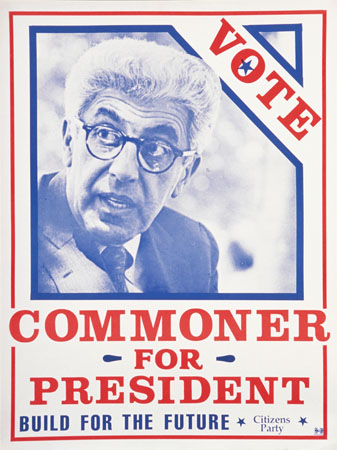
Vote Commoner for President
Peace Press
Offset, 1980
Los Angeles, CA
5930
CSPG’s Poster of the Week commemorates Barry Commoner, a founder of the modern ecology movement.  Commoner was one of the movement’s most provocative thinkers and mobilizers in making environmentalism a people’s political cause.  He died on Sunday in Manhattan; he was 95.
In the late 1950s, Dr. Commoner became well known for his opposition to nuclear weapons testing, becoming part of the team which demonstrated the presence of Strontium 90 in children’s teeth as a direct result of nuclear fallout.  His work contributed materially to the adoption of the Nuclear Test Ban Treaty of 1963.
In his bestselling 1971 book The Closing Circle, Dr. Commoner suggested that the American economy should be restructured to conform to the unbending laws of ecology. For example, he argued that polluting products (like detergents or synthetic textiles) should be replaced with natural products (like soap or cotton and wool). This book was one of the first to bring the idea of sustainability to a mass audience. Dr. Commoner suggested a left-wing, eco-socialist response to the limits to growth thesis, postulating that capitalist technologies were chiefly responsible for environmental degradation, as opposed to population pressures.
Dr. Commoner’s overarching concern was not ecology as such but rather a radical ideal of social justice in which everything was indeed connected to everything else. Like some other left-leaning dissenters of his time, he believed that environmental pollution, war, and racial and sexual inequality needed to be addressed as related issues of a central problem.
In 1980, Commoner founded the Citizens Party to serve as a vehicle for his ecological message, and he ran for President of the United States the same year. His official running mate was La Donna Harris. It is especially fitting to pay tribute to him during the season of presidential debates, when both the Democrats and Republicans strongly agree on at least one thing:  Not to allow Third Party Candidates  from participating in the debates!
One of Commoner's lasting legacies is his four laws of ecology, as written in The Closing Circle (1971). The four laws are:
  1. Everything is Connected to Everything Else. There is one ecosphere for all living organisms and what affects one, affects all.
  2. Everything Must Go Somewhere. There is no "waste" in nature and there is no "away" to which things can be thrown.
  3. Nature Knows Best. Humankind has fashioned technology to improve upon nature, but such change in a natural system is, says Commoner, "likely to be detrimental to that system."
  4. There Is No Such Thing as a Free Lunch. Exploitation of nature will inevitably involve the conversion of resources from useful to useless forms.
Commoner wrote this over 40 years ago.  When will we ever learn.
BARRY COMMONER
PRESENTE!
Sources:


Sunday, July 10, 2011

Poster of the Week


I Am No Longer Afraid of Mirrors
Sheila Levrant de Bretteville; Peace Press
Photograph by Hella Hammid
Los Angeles, California
1981

To commemorate the death of Betty Ford (1918-2011), an outspoken and gutsy Republican first lady who dared to break many national taboos—including talking about her breast cancer and her addiction to alcohol and pills. She also strongly supported a woman’s right to an abortion and the Equal Rights Amendment—both anathema’s to many Republicans.

In today’s cultural climate, where discussing addictions on talk shows is commonplace, and many wear pink ribbons to promote breast cancer awareness, it is hard to imagine that this openness has only developed over the last three decades. When Betty Ford was diagnosed with breast cancer in 1978, it was an unmentionable topic. It was not only kept secret from employers, but also from close friends and many family members. Breast cancer was considered a stigma, and following a mastectomy, many women felt ashamed and “no longer a complete woman.”

CSPG’s Poster of the Week shows feminist writer, poet, and teacher Deena Metzger triumphant and free, with the strength to reveal her mastectomy scar that has been camouflaged by a tattoo in the image of a tree branch in bloom. Describing the actual moment when the photo was taken, Metzger stated, “I just stood out there and opened my arms and said, yes to life.” This poster inspired many women—and their families—that life after cancer could be and should be celebrated and embraced without shame and without limits. Deena’s poem, inscribed on the poster, reads:

I am no longer afraid of mirrors where I see the sign of the amazon, the one who shoots arrows.
There was a fine red line across my chest where a knife entered,
but now a branch winds about the scar and travels from arm to heart.

Green leaves cover the branch, grapes hang there and a bird appears.
What grows in me now is vital and does not cause me harm. I think the bird is singing.
I have relinquished some of the scars.
I have designed my chest with the care given to an illuminated manuscript.
I am no longer ashamed to make love. Love is a battle I can win.
I have the body of a warrior who does not kill or wound.

On the book of my body, I have permanently inscribed a tree.

This poster and more than 100 others will be featured in “PEACE PRESS GRAPHICS 1967-1987: Art in the Pursuit of Social Change” at the University Art Museum (UAM), California State University, Long Beach, September 10 – December 11, 2011. The exhibition is a collaboration between the Center for the Study of Political Graphics and the UAM, and is part of the Getty’s regional initiative: Pacific Standard Time: Art in L.A. 1945-1980, the largest collaborative art project ever undertaken in Southern California.

Thursday, October 8, 2009

Blast from the Past: Carol Wells on the LA Peace Press

"Made in L.A. -- The L.A. Peace Press" CSPG director and founder Carol Wells and Los Angeles Valley College professor Henry Klein speak with Dateline USA host Duncan Elkinson about the L.A. Peace Press, April 22, 2005.